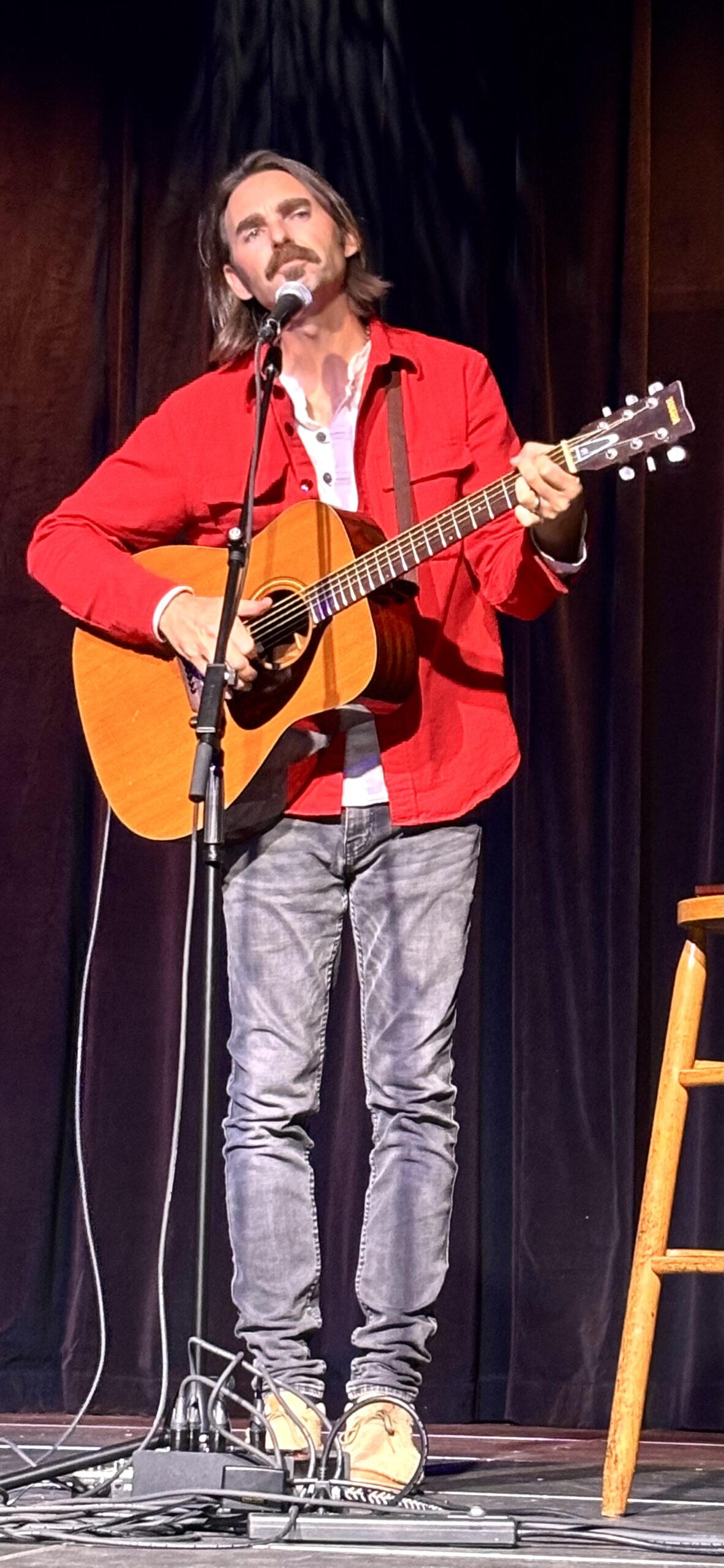
A sit-down with Sam Lewis
By:
Meagan Clements
… The Nashville, Tenn. singer-songwriter tells all — from American Idol and Taylor Swift to remaining independent and honing his craft with honesty and integrity.
Musician Sam Lewis finds sovereignty in many different things. His influences range from Ray Charles and Willie Nelson to Van Morisson, John Prine and Guy Clark. Although it has taken him time to find his artistic tribe, he is a songster with something worth saying.
“Everyone has something to say, and they have many platforms to do that,” Lewis said.
Lewis isn’t fond of the lottery or casting shows on national television.
“I don’t believe in the lottery of any line of work or field,” he said. “I think for people who create what they live and what they’ve experienced, it’s the long game if you’re not wanting to sell all of your soul.”
Lewis says shows like “American Idol” are entertainment in the most homogenized form.
“If McDonald’s and Mountain Dew came together, this is what their byproducts would look like,” he said. “It’s born out of curiosity and ‘what if.’ Lots of people that audition for these shows have something to say more than just their rendition of a cover.”
While he doesn’t throw shade at those who audition, he remains skeptical about the show’s lofty promises and the contestants’ hope of receiving a record deal.
“They genuinely are talented, but they’re kind of owned,” he said. “There’s a really bad underbelly to that type of entertainment.”
As an independent artist, Lewis supports a do-it-yourself model which places creative control in the hands of musicians.
“I think it’s a more accurate and realistic model,” he said.
Despite this, Lewis expresses concerns about the future of the music business.
“Music has sadly become background [noise] to a workout,” he confessed. “It’s consumed very differently than when I grew up listening to music.”
Lewis frowns upon the direction that artist development has drifted these days.
“Artist development is non-existent,” he said.
Regardless, Lewis says nothing is foolproof.
“One of the worst [persons] to try and develop an artist is an artist,” he said. “It’s a hard thing to manage because it’s happening in real time. It’s not just a painting that’s on the wall.”
Lewis remembers a time when there were no television shows turning young teens into overnight musical sensations.
“It was artist development in each sector going out and seeking things that moved them and touched them, not just [things that] could make money, but could be something,” he said.
Lewis praises artists that emerged in the 60s, 70s and 80s.
“Most of the artists that came out of the 60s, 70s, and 80s made two, three or four records before they even landed on the radar,” he said. “That took a machine, that took a lot of people making it happen.”
He agrees that artists were allowed the time necessary to create something from scratch.
“[Artists] were left alone and weren’t trying to figure out how to promote a show or manage their career,” he said. “Their job was to be isolated and create stuff. Now your average artist is responsible for everything that was once held in a brick and mortar.”
As for corporate music moguls, Lewis says they often miss the mark creatively speaking.
“They’re not listening with their emotions,” he said.
In the quiet of his Nashville home, Lewis, who is tall and thin and has a dry, unassuming sense of humor, occasionally questions his artistic limitations.
“Are they a byproduct of mediocrity?” he wondered. “We live in a time where just because you can do something, doesn’t mean you should. I constantly battle that. It’s the critic in me.”
While Lewis acknowledges cynicism in his own inner critic, he says it all boils down to one thing.
“Ultimately, it’s awareness,” he said.
Lewis isn’t fazed by Taylor Swift, Will Smith, or Chris Rock.
“It’s like when Will Smith slapped Chris Rock. It doesn’t concern me. I don’t know why my opinion would matter in that. Yeah, I saw it, and I don’t think you should physically attack people regardless of who you are, but who cares?” he said. “It doesn’t have anything to do with me. Taylor Swift and Will Smith may as well live on Mars because they kind of do. I don’t cross paths with them. I don’t have anything in common with them. There’s a lot of people like that.”
Lewis focuses not only on the type of music he makes, but on asking himself insightful questions.
“What level am I on?” he asked. “What lane am I in?”
Lewis often heads back in time, analyzing Ray Charles’ catalog.
“Look at Ray Charles’ catalog,” he said. “Out of all of the albums he made, he maybe wrote 20 songs and none of them were really hits. They were just Ray Charles songs.”
Lewis acknowledges that there was a time when everybody championed not only the songwriter, but the song itself.
“Willie Nelson — some of his best songs were written by other people,” he noted.
When it comes to the most overrated quality in a performer, Lewis isn’t shy about expressing his opinion.
“When I think of performing, I think of being on stage, but also, we perform on social media too,” he confessed. “If I were to go to your social media account and I’m not really seeing or hearing anything about what it is that you do, like your art, then I think it’s all overrated.”
He sighed.
“I just made a video this morning about [how I sell hoodies]. I even have complexities with doing stuff like that,” he admitted. “Ultimately, it gets people to the website where they can see my tours, my public calendar. Maybe they don’t buy a hoodie, but they buy tickets to a show.”
Lewis says it’s about finding the right balance.
“If I did a post every single day talking about a show that I’m playing at, what’s going to happen is people are going to disengage,” he said. “I’m probably promoting shows in regions that people don’t even live in.”
Email marketing hasn’t proven to be any easier.
“Sometimes people unsubscribe to my newsletter if I’m promoting a UK tour because it doesn’t apply to them,” Lewis said. “They don’t even comment on it when they live across the pond.”
For fans investing time into seeing Lewis live, he offers more than just music for those who wish to take a piece of him home with them.
“I’m not singing songs so that you buy a t-shirt. I just have something like that to offer in case you don’t own a CD player or spin vinyl,” he said. “It’s something else that you can take with you.”
Lewis makes light-hearted conversation throughout his live sets to keep eyes and ears engaged.
“I’m not in the shirt-making business but it just happens to be on the merch table, so why not talk about it on stage?” he asked. “Maybe you don’t talk about it on stage but nevertheless, all the lines parallel one another to hopefully remind people, ‘Oh, yeah! I saw that guy! You should listen to his music.’ It’s all connective tissue for sure.”
Lewis isn’t concerned about shows that don’t sell out, either.
“I think in some ways it makes it easier because you get to engage with people,” he said.
Learning to let things go hasn’t happened overnight.
“It’s taken years to get to that place of comfort where it’s [no longer] my concern,” Lewis confessed. “There are so many things that are just not my concern. For a place to not be sold out or to be really thin or whatever, by the time I come out there, my whole goal is to not even make that a conversation. I don’t even want to acknowledge that.”
The number of people in a room is one thing Lewis strips from his subconscious.
“It’s irrelevant because whatever it was intended to be, it’s happening right now,” Lewis said. “This is our time whether there’s 300 people or 30 people there. This is the show that you’re getting. I can’t take things like that too personally. They don’t really validate anything for me.”
Patricia Marie was lucky enough to catch Lewis on one of his tours, applauding the troubadour’s mesmerizing delivery and on-stage persona.
“He was truly authentic in a cookie-cutter world,” Marie said, looking back at a photo she snapped of Lewis with shoulder-length hair tucked behind his ears and a coffee-colored mustache.
Lewis values keeping lines of communication open with historic theaters and other intimate venues for listening to and performing live music.
“You gotta think about it from a consumer standpoint and a business standpoint,” he began. “The bigger the space, the more [people] you have to employ and the more service charges and fees there are, and so on and so forth. The expenses can become overwhelming and not worthwhile whether you’re a performer or a buyer.”
Lewis, who mostly tours solo acoustic and has been spotted wearing a pair of suede boots, blue jeans and a red flannel shirt, says it comes down to monetary perspectives.
“I don’t play a lot of festivals for a couple different reasons,” he admitted. “The larger the space, the larger the occupancy and you’re asking a lot of people to stay engaged. At times, it can be counterproductive to be in bigger rooms.”
He stays in constant communication with every promoter, talent agent and buyer.
“Working in tandem with them gives me a better understanding of not just what should be done but what is actually being done and holding myself accountable, too,” he said. “You can only post about so many shows in certain places so many times where it’s not as effective.”
Lewis says every artist is continually developing as well as reengaging with audiences large and small.
“If you’re not selling out rooms, you’re developing,” he admitted. “You’re going to places that you haven’t been and where people haven’t seen you before.”
Lewis agrees that it’s the responsibility of the venue and the concert promoter to build awareness.
“There’s only so much bandwidth that I have,” he said.
Lewis praises youbloom’s philosophy on giving artists and music aficionados a voice in the equation.
“Everybody has a voice, and I think most of those voices should be heard,” he acknowledged.
Lewis’ philosophy weaves throughout his music.
“We’re all cut from a different thread, sometimes you’re blue, sometimes you’re red,” he sings. He’s found the sweet spot within his vocal range and listeners are here for it.
For Lewis, whose artistic accents offer Americana and no-frills fingerstyle on a Yamaha acoustic guitar, it comes full circle back to accountability.
“I think it’s good to see and hear what people have to say because a lot is expected of all of us,” he said. “There is a downside to underselling a show as a consumer. It’s confusing to go to a show, especially a room that is less than half filled. You actually enter a sense of, ‘Have I been fooled?’”
He says no matter the downside, everyone is human.
“We’re consumers and we’re human. We like to buy things and use things that other people use,” he said. “We respect other people‘s decisions, especially if they’ve sold us on stuff whether we really need it or not. It’s validating and we like to have that as consumers.”
He is optimistic about the many promises youbloom has to offer.
“There’s a great place right now for youbloom and what it offers,” he said confidently.
youbloom CEO Phil Harrington is a musician himself. Harrington is influenced by Neil Young — among others — and even enjoys listening to Lewis.
“One of the things that just always echoed with me is the challenges that artists have in getting shows,” he said, tapping into the artistry of Lewis.
Lewis is thankful for the renovation of historic theaters, including Bay Theater in Seal Beach, Calif.
“My favorite thing about it is that it actually happens and that we get to be a part of that,” he said, smiling. “These theaters, you know, I worship them. They have sustained depressions, recessions and pandemics. It’s one of the most notable and charitable contributions in regard to the arts for people to pour not just money but a lot of their time into at least restoring them or keeping them alive. I think they’re the best place to see live entertainment.”
His art remains meaningful and musing, whether his glass is half full or half empty.
“Depending on [whether] your glass is half full or half empty, you can go, ‘What’s the point of just throwing more stuff into the abyss?’” he asked. “If you set out with that in mind, you’re probably not going to be impressed with what you have to offer the world.”
Saundri Luipold is the former, co-editor-in-chief of The West Wind, a literary journal fostering creativity of young adults through Azusa Pacific University in Azusa, Calif. Luipold was eager to shed light on Lewis’ storytelling, noting that one song in particular, “Virginia Avenue,” caught her eye.
“On a surface level, the slowness of the music itself matches the meaning of a slow, small-town life,” Luipold began. “On a deeper level, something I noticed is that the lyrics don’t seek to come to any kind of grand conclusion or answer a question. Rather, they sit in the slowness of the surroundings on Virginia Avenue, [citing] the neighbors and friends by name, describing the car that won’t start and the dogs that bark.”
Luipold smiled thoughtfully.
“This song might make some listeners think of home and what it means to have roots in a place,” she added. “It is exactly what one wants when looking for a classic folksy tune.”
The first time a listener known as Ginny heard Lewis’ music, she settled into the songster’s heartfelt hooks and homestyle tunes.
“His style struck me as a cross between country and bluegrass,” she said. “I [especially] loved the tone of the guitar. I wasn’t sure if there was an electric guitar, a lap steel guitar or a dobro.”
Ginny took comfort in Lewis’ vocal prowess adding, “The music is very well produced.”
Lewis is interested in all fabrics of society and tries his best to remain present at each moment of life.
Being in the present takes very, very little. It just takes you,” he said with eyes as blue as the ocean.
On tour, Lewis is frequently found signing autographs and posing for pictures with his fans. He is characterized as pleasant and unpretentious.
When he’s not performing or crafting compelling narratives, Lewis is an avid reader, enjoys leisurely strolls around his Nashville neighborhood and gets lost in his favorite podcast — “The Blind Boy Boat Club.”
“He’s an interesting character. He wears a bag on his face because he’s not interested in what I think most people are interested in when success comes along, which is recognition,” he said. “He’s actually very, very anti-that.”
Although Lewis is proud of his 2024 release, “Superposition,” he has new things on the horizon, including an album on the way. ‘Gentle’ is the first word that comes to mind when describing his latest record, “Everything’s Fine,” which is set for a spring 2026 release.
“It’s being manufactured as we speak,” he said excitedly. “The first single is going to come out in January.”
Lewis thought for a moment.
“I have been calling it the departure from my departure,” he laughed. “Sonically, we reel it in quite a bit. It is very, very intimate.”
Additionally, the record feels like home for the straight-haired songster.
“It is very representative of where I currently am as a human,” he said, adding, “I try my best to not make the same album twice.”
Lewis shared a few in-studio secrets for die-hard and casual listeners alike.
“We did have a little bit of fun with a couple of toys in the studio, but it’s not as ethereal and spacey as Superposition was sonically,” he said.
To learn more, visit https://www.samlewistunes.com/.